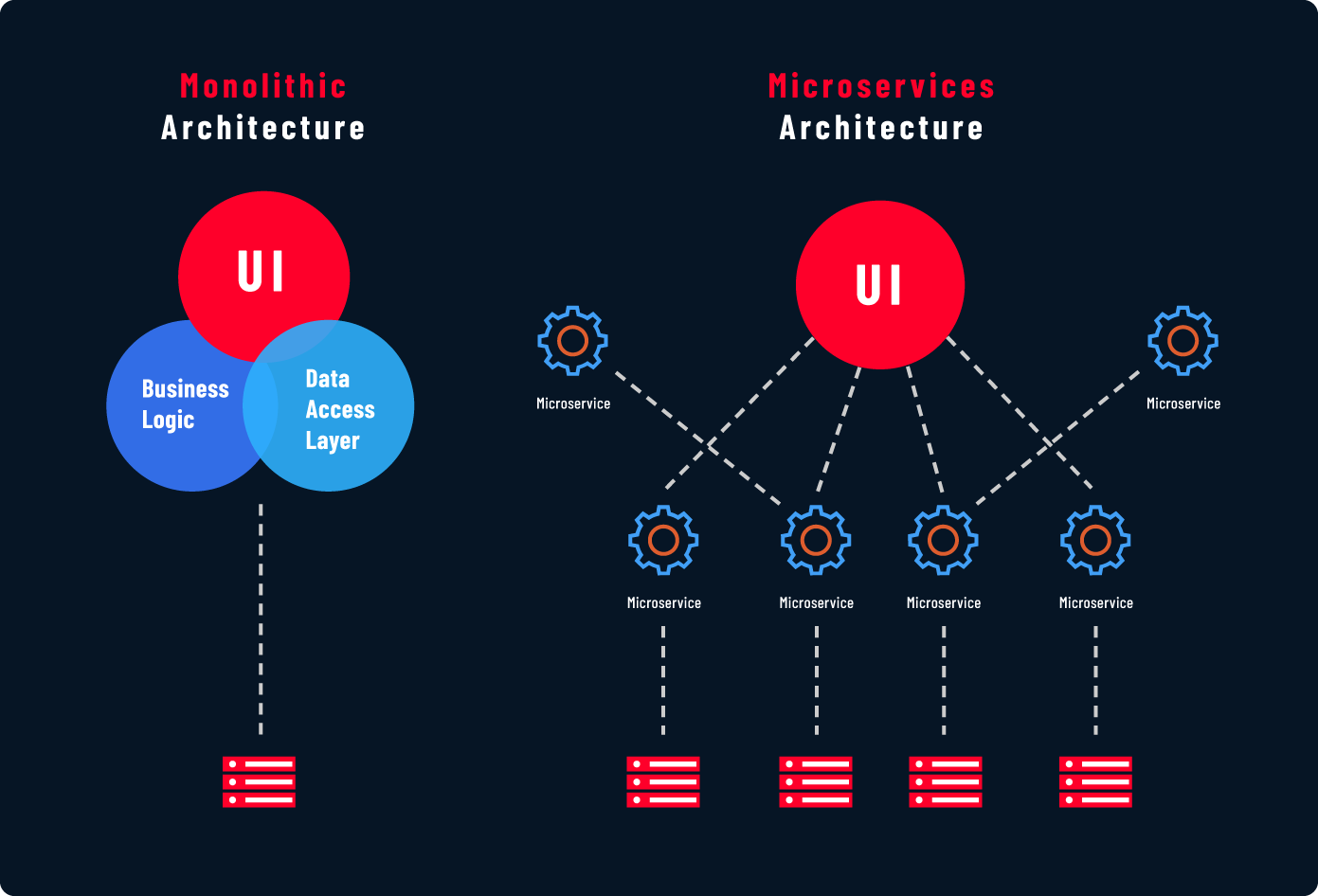
Monolithic vs Microservices Architecture: Choosing the Right Approach for Your Project
When building a web application, one of the most critical technical decisions is selecting the right architecture. Two popular approaches dominate modern development: monolithic architecture and microservices architecture. Each has its own strengths and trade-offs, and the right choice depends on your project’s scale, goals, and team structure.
Understanding these architectural patterns is especially important for businesses planning long-term growth or looking to hire dedicated developers who can design scalable and maintainable systems.
What Is Monolithic Architecture?
In a monolithic architecture, the entire application is built as a single, unified codebase. All components—frontend, backend logic, and database interactions—are tightly integrated and deployed together.
This approach is simple and straightforward, making it a common choice for small to medium-sized projects, MVPs, or early-stage products that rely on streamlined full stack development without complex infrastructure.
What Is Microservices Architecture?
Microservices architecture breaks an application into smaller, independent services. Each service handles a specific business function and communicates with others through APIs.
These services can be developed, deployed, and scaled independently, offering greater flexibility for complex applications. Many growing businesses adopt this approach when they work with experienced teams through IT consulting services to plan architecture, cloud adoption, and deployment strategies.
Key Differences Between Monolithic and Microservices
Development Complexity
Monolithic applications are easier to develop initially, while microservices require careful planning, service boundaries, and inter-service communication.
Scalability
Microservices allow individual components to scale independently, whereas monolithic applications scale as a whole, which can become inefficient as traffic increases.
Deployment
A small change in a monolithic application requires redeploying the entire system. In microservices, only the affected service needs updating, reducing deployment risks for large platforms.
Maintenance
Microservices are easier to maintain in the long run for complex systems, particularly when projects are handled using outsourced development models, while monoliths are simpler to manage at an early stage.
When Should You Choose a Monolithic Architecture?
Monolithic architecture is ideal if:
You are building a startup MVP
Your team is small
The project has limited complexity
Fast initial development is a priority
It allows you to focus on delivering core functionality quickly without the overhead of managing multiple services.
When Should You Choose Microservices?
Microservices are a better choice if:
Your application is large or rapidly growing
You need high scalability and availability
Multiple teams are working on the same product
You expect frequent updates and feature expansion
This approach works particularly well when you hire developers with specialized skills to manage individual services efficiently.
Final Thoughts
There is no one-size-fits-all solution when choosing between monolithic and microservices architecture. Monolithic systems offer simplicity and speed, while microservices provide scalability and flexibility for complex applications.
The best approach is to align your architecture with your business goals, team capabilities, and long-term vision. Making the right architectural decision early—along with the right development strategy—can significantly reduce technical debt and future rework.