Microservices vs Monolithic Architecture: Choosing the Right Approach
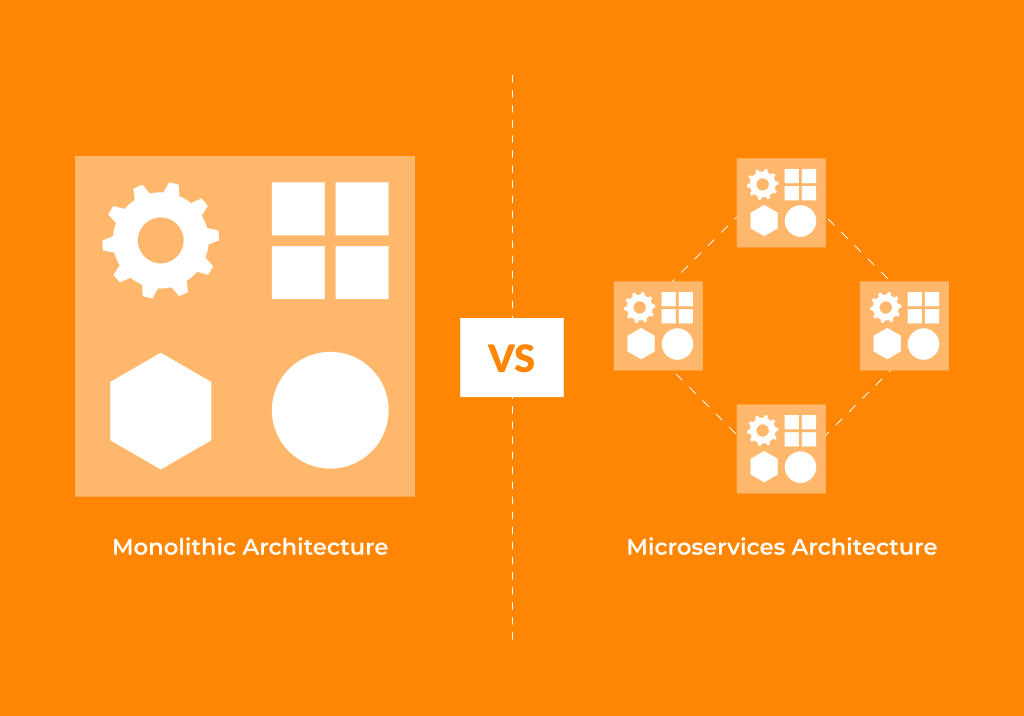
When building applications, one of the most fundamental decisions involves architectural style. Monolithic architecture bundles all functionality into a single codebase, while microservices split applications into independent services that communicate through APIs. Both approaches have merit, and understanding their tradeoffs helps organizations choose strategies that align with their needs, resources, and goals.
Understanding Monolithic Architecture
Monolithic applications organize all code—user interface, business logic, data access—into one unified codebase. Everything deploys together, shares the same database, and runs as a single process. This simplicity offers advantages for smaller applications and teams just starting out.
Development moves quickly initially. Developers understand the entire application, debugging traces issues through single codebases, and testing verifies everything works together. Deployment is straightforward—build once, deploy once. For startups validating ideas or small teams with limited resources, monoliths provide the fastest path from concept to working product.
However, as applications grow, monolithic architectures reveal limitations. Changing one feature requires redeploying everything. Scaling means replicating entire applications even when only specific components need additional capacity. Code becomes entangled as dependencies between modules multiply, making modifications risky and time-consuming.
The Microservices Alternative
Microservices architecture decomposes applications into small, independent services, each handling specific business capabilities. User authentication runs as one service, payment processing as another, inventory management as a third. These services communicate through well-defined APIs, enabling independent development, deployment, and scaling.
This independence delivers significant benefits. Teams work autonomously on different services without coordinating every change. Services scale individually based on actual demand—add more payment processing capacity during checkout peaks without scaling the entire application. Technology choices become flexible, with services using different languages, databases, or frameworks best suited for specific tasks.
Organizations transitioning from monoliths to microservices often partner with experienced IT consulting teams who can guide architectural decisions and help avoid common pitfalls that derail microservices migrations.
Complexity Considerations
Microservices introduce complexity that monoliths avoid. Services must discover and communicate with each other across networks. Distributed transactions become complicated when operations span multiple services. Debugging issues requires tracing requests across many services, each with separate logs.
Deployment complexity multiplies as dozens or hundreds of services require individual management. Configuration management becomes critical when each service needs specific settings. Monitoring and observability tools become essential for understanding system behavior across distributed components.
This complexity requires infrastructure and expertise that smaller teams may lack. Kubernetes, service meshes, distributed tracing, and centralized logging all solve microservices challenges but require knowledge and effort to implement correctly.
When Monoliths Make Sense
Starting with monolithic architecture often makes sense. Small teams benefit from simplicity that enables rapid development. Unknown requirements benefit from flexibility to refactor entire codebases easily. Resource constraints favor avoiding microservices overhead.
Many successful companies started with monoliths and migrated to microservices only after reaching scale where monolithic limitations became painful. Premature microservices adoption adds complexity without corresponding benefits when applications don’t yet need independent scaling or team autonomy.
Transitioning Strategies
Organizations outgrowing monolithic architectures don’t need complete rewrites. Strangler fig patterns gradually extract functionality into services while keeping monoliths running. Start by identifying bounded contexts—clear functional boundaries—and extract the most problematic or frequently changing components first.
This incremental approach reduces risk compared to big-bang rewrites. Teams learn microservices patterns while maintaining working systems. If problems arise, rolling back individual services is easier than unwinding complete architectural overhauls. Successfully executing these complex transitions often requires bringing in specialists who hire dedicated developers experienced in both monolithic and microservices patterns to ensure smooth migrations.
Team Structure Matters
Conway’s Law observes that system architectures mirror organizational structures. Microservices work best when teams align with services, owning complete functionality from development through deployment and operations. Organizations with siloed teams—separate frontend, backend, database groups—struggle with microservices that demand cross-functional ownership.
Building effective microservices teams requires not just technical skills but also strong project coordination. Experienced IT project managers help align team structures, define service boundaries, and establish communication patterns that prevent the chaos that can result from poorly planned microservices architectures.
Making the Right Choice
Neither architecture is universally superior. Monoliths suit small teams, simple applications, and rapid prototyping. Microservices enable scale, team autonomy, and technology flexibility at the cost of operational complexity. The best choice depends on specific circumstances rather than following trends. Smart organizations choose architectures that solve actual problems rather than creating new ones.